


Unlocking the Global Pathways to Resilience, Growth, and Sustainability for 2030
Unlocking the Global Pathways to Resilience, Growth, and Sustainability for 2030
Source: https://www.accenture.com/
Only logged in customers who have purchased this product may leave a review.
Related products

Making The Right Choices For Your Utility: Using Sustainability Criteria For Water Infrastructure Decision Making
Introduction and Purpose of This Guide
Having the capacity to compare a range of infrastructure alternatives objectively is critical to a water or wastewater utility’s long-term sustainability and its ability to serve the needs of its community. This guide is designed to help water and wastewater utilities undertake these critical comparisons, in the context of meeting their existing regulatory requirements and improving the sustainability of utility operations.
This document is designed to supplement the United States Environmental Protection Agency’s (EPA) Planning for Sustainability: A Handbook for Water and Wastewater Utilities (“the Handbook”), issued in February 2012. The Handbook identifies a number of steps utilities can take to incorporate sustainability considerations into their existing planning processes, organized around four core elements of planning
commonly used by utilities:
• PLANNING ELEMENT 1: Goal Setting – Establish sustainability goals that reflect utility and community priorities.
• PLANNING ELEMENT 2: Objectives and Strategies – Establish objectives and strategies for each sustainability goal.
• PLANNING ELEMENT 3: Alternatives Analysis – Analyze a range of alternatives based on consistent criteria.
• PLANNING ELEMENT 4: Financial Strategy – Ensure that investments are sufficiently funded, operated, maintained, and replaced over time.
Making The Right Choices For Your Utility: Using Sustainability Criteria For Water Infrastructure Decision Making
Introduction and Purpose of This Guide
Having the capacity to compare a range of infrastructure alternatives objectively is critical to a water or wastewater utility’s long-term sustainability and its ability to serve the needs of its community. This guide is designed to help water and wastewater utilities undertake these critical comparisons, in the context of meeting their existing regulatory requirements and improving the sustainability of utility operations.
This document is designed to supplement the United States Environmental Protection Agency’s (EPA) Planning for Sustainability: A Handbook for Water and Wastewater Utilities (“the Handbook”), issued in February 2012. The Handbook identifies a number of steps utilities can take to incorporate sustainability considerations into their existing planning processes, organized around four core elements of planning
commonly used by utilities:
• PLANNING ELEMENT 1: Goal Setting – Establish sustainability goals that reflect utility and community priorities.
• PLANNING ELEMENT 2: Objectives and Strategies – Establish objectives and strategies for each sustainability goal.
• PLANNING ELEMENT 3: Alternatives Analysis – Analyze a range of alternatives based on consistent criteria.
• PLANNING ELEMENT 4: Financial Strategy – Ensure that investments are sufficiently funded, operated, maintained, and replaced over time.

Sustainable Development of Energy, Water and Environment Systems (SDEWES 2021)
This book contains collections of selected articles presented at the SDEWES2021 conference and subsequently published in a special issue of Sustainability. The book provides state-of-the-art research, overviewing practices in sustainable development, energy, water and environment systems, as well as their uses and applications. Focus is given to waste management; higher biomass production; biorefineries; bio-digital interface and microbial fuel cells; energy and cost reduction in the building sector; and the economic impact of sustainability.
Sustainable Development of Energy, Water and Environment Systems (SDEWES 2021)
This book contains collections of selected articles presented at the SDEWES2021 conference and subsequently published in a special issue of Sustainability. The book provides state-of-the-art research, overviewing practices in sustainable development, energy, water and environment systems, as well as their uses and applications. Focus is given to waste management; higher biomass production; biorefineries; bio-digital interface and microbial fuel cells; energy and cost reduction in the building sector; and the economic impact of sustainability.

Achieving Water-Energy-Food Nexus Sustainability: a Science and Data Need or a Need for Integrated Public Policy?
This book is a collection of articles from a Frontiers Research Topic. Frontiers Research Topics are very popular trademarks of the Frontiers Journals Series: they are collections of at least ten articles, all centered on a particular subject. With their unique mix of varied contributions from Original Research to Review Articles, Frontiers Research Topics unify the most influential researchers, the latest key findings and historical advances in a hot research area
Achieving Water-Energy-Food Nexus Sustainability: a Science and Data Need or a Need for Integrated Public Policy?
This book is a collection of articles from a Frontiers Research Topic. Frontiers Research Topics are very popular trademarks of the Frontiers Journals Series: they are collections of at least ten articles, all centered on a particular subject. With their unique mix of varied contributions from Original Research to Review Articles, Frontiers Research Topics unify the most influential researchers, the latest key findings and historical advances in a hot research area

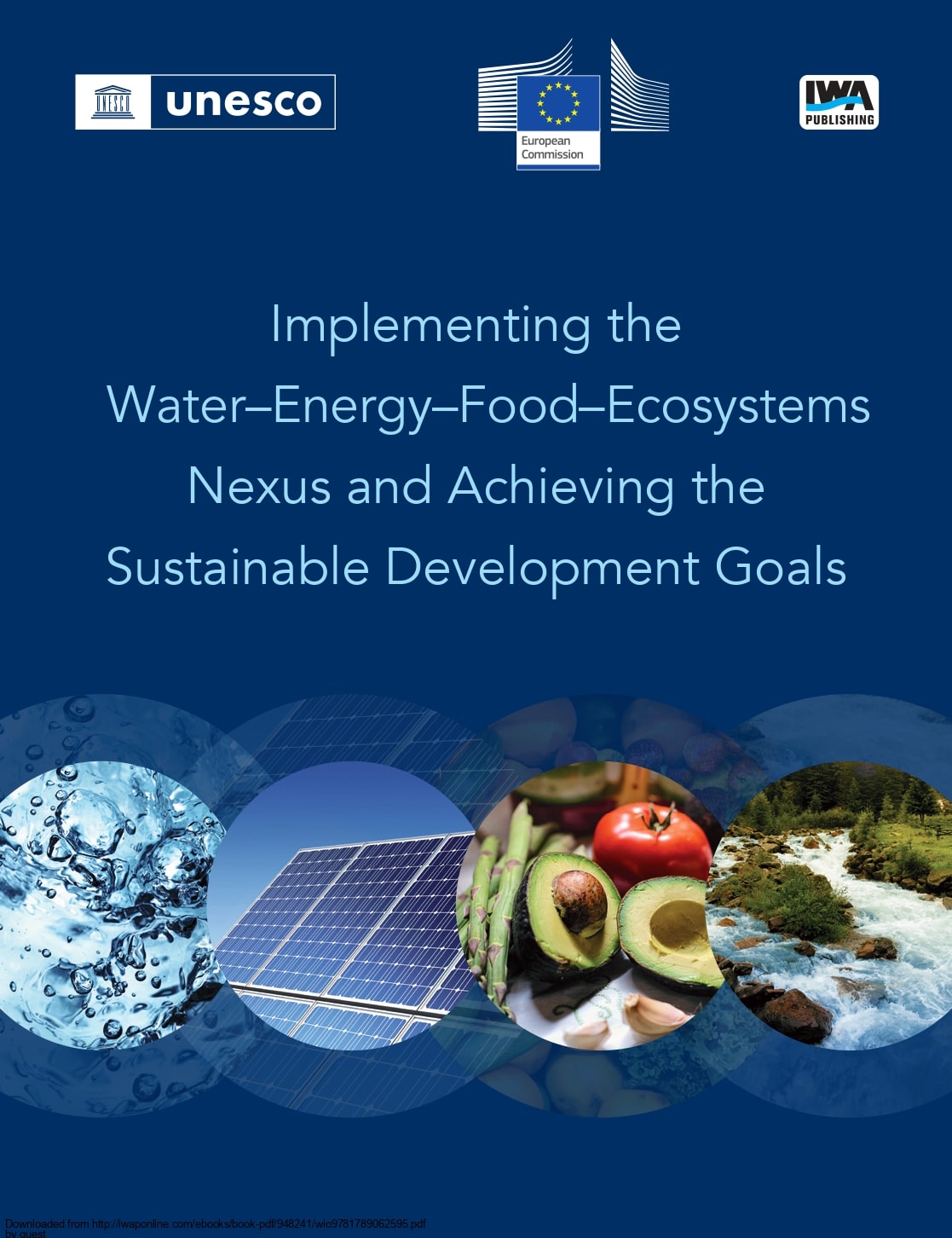
Implementing the Water–Energy–Food–Ecosystems Nexus and Achieving the Sustainable Development Goals
This document brings together a number of contributions, case studies, and experiences with the aim of highlighting the importance and benefits of the WEFE Nexus as an approach and methodology for development cooperation in general. It makes special reference to the main conclusions of the WEFE Nexus specific workshop held in Brussels jointly organized by JRC and INTPA and held on 25–26 January 2018. The workshop was oriented towards implementing and operationalizing the Nexus approach with the objective of improving the sustainability of the intervention projects and programmes based on the experience of the Nexus experts in a variety of projects and regions. This document should be read as a practical guide to fully understand key aspects of WEFE Nexus and is presented in non-technical language for ease of access and uptake for a wider audience.
Implementing the Water–Energy–Food–Ecosystems Nexus and Achieving the Sustainable Development Goals
This document brings together a number of contributions, case studies, and experiences with the aim of highlighting the importance and benefits of the WEFE Nexus as an approach and methodology for development cooperation in general. It makes special reference to the main conclusions of the WEFE Nexus specific workshop held in Brussels jointly organized by JRC and INTPA and held on 25–26 January 2018. The workshop was oriented towards implementing and operationalizing the Nexus approach with the objective of improving the sustainability of the intervention projects and programmes based on the experience of the Nexus experts in a variety of projects and regions. This document should be read as a practical guide to fully understand key aspects of WEFE Nexus and is presented in non-technical language for ease of access and uptake for a wider audience.

Hitachi Sustainability Report 2022
The Hitachi Sustainability Report 2022 presents our stance toward environmental (E), social (S), and governance (G) issues and details the activities we undertook in relation to these in fiscal 2021.
Hitachi Sustainability Report 2022
The Hitachi Sustainability Report 2022 presents our stance toward environmental (E), social (S), and governance (G) issues and details the activities we undertook in relation to these in fiscal 2021.


Dairy Sector Opportunities and Sustainability Challenges
The global dairy industry is experiencing rapid transitions and it is worthy to regularly share some of the updated vital information with all the relevant stakeholders. In this regard, this book, which is an outcome of the SI: “Dairy Sector: Opportunities and Sustainability Challenges” (Sustainability journal), covers various topics relevant to available opportunities and overcoming recurrent sustainability challenges in the entire dairy sector.
Dairy Sector Opportunities and Sustainability Challenges
The global dairy industry is experiencing rapid transitions and it is worthy to regularly share some of the updated vital information with all the relevant stakeholders. In this regard, this book, which is an outcome of the SI: “Dairy Sector: Opportunities and Sustainability Challenges” (Sustainability journal), covers various topics relevant to available opportunities and overcoming recurrent sustainability challenges in the entire dairy sector.
Reviews
There are no reviews yet.