

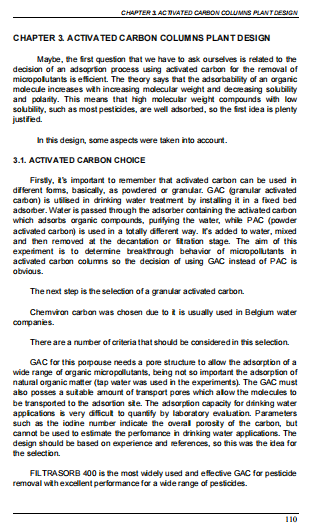
Chapter 3. Activated Carbon Columns Plant Design
Maybe, the first question that we have to ask ourselves is related to the decision of an adsorprtion process using activated carbon for the removal of micro pollutants is efficient. The theory says that the adsorbability of an organic molecule increases with increasing molecular weight and decreasing solubility and polarity. This means that high molecular weight compounds with low solubility, such as most pesticides, are well adsorbed, so the first idea is plenty justified.
Only logged in customers who have purchased this product may leave a review.
Related products
Design Characteristics For Evaporation Ponds In Wyoming
ABSTRACT:
Information for the design of evaporation ponds in Wyoming has been developed. The suitability of various models for estimating evaporation and its variability was investigated while the spatial and temporal variabilities of net evaporation at seven locations were described. A routing procedure was developed to analyze the effects of uncertainty in net evaporation estimates on the probability of pond failure. Comparison of equations which estimate evaporation using climatological data showed that the equations vary greatly in their ability to define the variability of evaporation. The Kohler-Nordenson-Fox equation provided monthly and annual evaporation estimates having statistics resembling those of
measured pan data closer than any of seven other equations tested. The equation requires temperature, radiation, wind, and humidity data as inputs. The Kohler-Nordenson-Fox equation using climatic data extrapolated from nearby stations provided better definition of the variability of evaporation than did equations requiring only on-site temperature data. However, results indicate that extreme care must be taken in selecting the stations from which data will be extrapolated. Monthly and annual means, standard deviations, and highest and lowest evaporation and net evaporation values have been calculated for seven Wyoming stations. The year-to-year and spatial variation of evaporation and/or net evaporation in Wyoming was shown to be great enough to cause serious problems in defining rates for evaporation pond designs. Several factors were shown to exist which might produce uncertainties in any estimate of evaporation. The routing procedure was applied to analyze the effects of these uncertainties and variations. Results indicate that the liquid depth of an evaporation pond depends greatly on evaporation rates and maintenance of minimum liquid depths without pond overflow is very difficult.
Design Characteristics For Evaporation Ponds In Wyoming
ABSTRACT:
Information for the design of evaporation ponds in Wyoming has been developed. The suitability of various models for estimating evaporation and its variability was investigated while the spatial and temporal variabilities of net evaporation at seven locations were described. A routing procedure was developed to analyze the effects of uncertainty in net evaporation estimates on the probability of pond failure. Comparison of equations which estimate evaporation using climatological data showed that the equations vary greatly in their ability to define the variability of evaporation. The Kohler-Nordenson-Fox equation provided monthly and annual evaporation estimates having statistics resembling those of
measured pan data closer than any of seven other equations tested. The equation requires temperature, radiation, wind, and humidity data as inputs. The Kohler-Nordenson-Fox equation using climatic data extrapolated from nearby stations provided better definition of the variability of evaporation than did equations requiring only on-site temperature data. However, results indicate that extreme care must be taken in selecting the stations from which data will be extrapolated. Monthly and annual means, standard deviations, and highest and lowest evaporation and net evaporation values have been calculated for seven Wyoming stations. The year-to-year and spatial variation of evaporation and/or net evaporation in Wyoming was shown to be great enough to cause serious problems in defining rates for evaporation pond designs. Several factors were shown to exist which might produce uncertainties in any estimate of evaporation. The routing procedure was applied to analyze the effects of these uncertainties and variations. Results indicate that the liquid depth of an evaporation pond depends greatly on evaporation rates and maintenance of minimum liquid depths without pond overflow is very difficult.





Guidelines For Wastewater Reuse In Agriculture And Aquaculture
There has been an increasing interest in reuse of wastewater in agriculture over the last few decades due to increased demand for freshwater. Population growth, increased per capita use of water, the demands of industry and of the agricultural sector all put pressure on water resources. Treatment of wastewater provides an effluent of sufficient quality that it should be put to beneficial use and not wasted (Asano, 1998). The reuse of wastewater has been
successful for irrigation of a wide array of crops, and increases in crop yields from 10-30% have been reported (cited in Asano, 1998). In addition, the reuse of treated wastewater for irrigation and industrial purposes can be used as strategy to release freshwater for domestic use, and to improve the quality of river waters used for abstraction of drinking water (by reducing disposal of effluent into rivers).
Guidelines For Wastewater Reuse In Agriculture And Aquaculture
There has been an increasing interest in reuse of wastewater in agriculture over the last few decades due to increased demand for freshwater. Population growth, increased per capita use of water, the demands of industry and of the agricultural sector all put pressure on water resources. Treatment of wastewater provides an effluent of sufficient quality that it should be put to beneficial use and not wasted (Asano, 1998). The reuse of wastewater has been
successful for irrigation of a wide array of crops, and increases in crop yields from 10-30% have been reported (cited in Asano, 1998). In addition, the reuse of treated wastewater for irrigation and industrial purposes can be used as strategy to release freshwater for domestic use, and to improve the quality of river waters used for abstraction of drinking water (by reducing disposal of effluent into rivers).


IMS Design Quick Start Guide
The IMSDesign Quick Start Guide contains information about how you can install the Integrated Membrane System Design (IMSDesign) application. Additionally, this guide contains detailed information about setting the options related to different modules of the application.
IMS Design Quick Start Guide
The IMSDesign Quick Start Guide contains information about how you can install the Integrated Membrane System Design (IMSDesign) application. Additionally, this guide contains detailed information about setting the options related to different modules of the application.


Chilled Water Plant Design Guide
Introduction:
Many large buildings, campuses, and other facilities have plants that make chilled water and distribute it to air handling units and other cooling equipment. The design operation and maintenance of these chilled water plants has a very large impact on building energy use and energy operating cost. Not only do chilled water plants use very significant amounts of electricity (as well as gas in some cases), they also significantly contribute to the peak load of buildings. The utility grid in California, and in many other areas of the country, experiences its maximum peak on hot summer days. During this peak event, chilled water plants are often running at maximum capacity. When temperatures are moderate, chilled water plants are shut down or operated in stand-by mode. This variation in the rate of energy use is a major contributor to the peaks and valleys in energy demand, which is one of the problems that must be addressed by utility grid managers. Most buildings and facilities that have chilled water plants have special utility rates where the cost of electricity depends on when it is used and the maximum rate of use. For instance, PG&E has five time charge periods: summer on-peak, summer mid-peak, summer off-peak, winter mid-peak and winter off-peak. The price of electricity is several times higher during the summer on-peak than it is during the off-peak periods. Not only does the cost of electricity vary, but most utility rates also have a monthly demand charge based on the maximum rate of electricity use for the billing period. Since chilled water plants operate more intensely during the summer peak period, efficiency gains and peak reductions can result in very large utility bill savings. In addition to new construction, the chilled water plants of many existing buildings are being replaced or overhauled. Older chilled water plants have equipment that uses ozone-damaging refrigerants. International treaties, in particular the Montreal Protocol, call for ozone damaging chemicals (in particular CFCs) to be phased out of production. As the availability of CFCs is reduced, the price will skyrocket, creating pressure for chilled water plants to be overhauled or replaced.
Chilled Water Plant Design Guide
Introduction:
Many large buildings, campuses, and other facilities have plants that make chilled water and distribute it to air handling units and other cooling equipment. The design operation and maintenance of these chilled water plants has a very large impact on building energy use and energy operating cost. Not only do chilled water plants use very significant amounts of electricity (as well as gas in some cases), they also significantly contribute to the peak load of buildings. The utility grid in California, and in many other areas of the country, experiences its maximum peak on hot summer days. During this peak event, chilled water plants are often running at maximum capacity. When temperatures are moderate, chilled water plants are shut down or operated in stand-by mode. This variation in the rate of energy use is a major contributor to the peaks and valleys in energy demand, which is one of the problems that must be addressed by utility grid managers. Most buildings and facilities that have chilled water plants have special utility rates where the cost of electricity depends on when it is used and the maximum rate of use. For instance, PG&E has five time charge periods: summer on-peak, summer mid-peak, summer off-peak, winter mid-peak and winter off-peak. The price of electricity is several times higher during the summer on-peak than it is during the off-peak periods. Not only does the cost of electricity vary, but most utility rates also have a monthly demand charge based on the maximum rate of electricity use for the billing period. Since chilled water plants operate more intensely during the summer peak period, efficiency gains and peak reductions can result in very large utility bill savings. In addition to new construction, the chilled water plants of many existing buildings are being replaced or overhauled. Older chilled water plants have equipment that uses ozone-damaging refrigerants. International treaties, in particular the Montreal Protocol, call for ozone damaging chemicals (in particular CFCs) to be phased out of production. As the availability of CFCs is reduced, the price will skyrocket, creating pressure for chilled water plants to be overhauled or replaced.

Design of Water Hammer Shock Absorber
Abstract:
In the piping system, water hammer or hydraulic shock is a major issue that engineers need to consider. Water hammer is a phenomenon that leads to shock waves in the fluid due to rapid closing and opening of the valve, which can affect pipes, valves and gauges in any water, gas, or oil applications due to the sudden transient event. It is there for every system that has a flow of fluid through pumping such as houses, hospitals, and influences major effectiveness in the power plant. It occurs when there is a pressure difference in the pipeline leading to a loud noise. Specifically, this project is aimed to design a pipeline system and develop solutions to reduce the water hammer using a shock absorber. The main idea of the design project is to design a water hammer system using a shock absorber in order to reduce the shock waves of the pipes.
Design of Water Hammer Shock Absorber
Abstract:
In the piping system, water hammer or hydraulic shock is a major issue that engineers need to consider. Water hammer is a phenomenon that leads to shock waves in the fluid due to rapid closing and opening of the valve, which can affect pipes, valves and gauges in any water, gas, or oil applications due to the sudden transient event. It is there for every system that has a flow of fluid through pumping such as houses, hospitals, and influences major effectiveness in the power plant. It occurs when there is a pressure difference in the pipeline leading to a loud noise. Specifically, this project is aimed to design a pipeline system and develop solutions to reduce the water hammer using a shock absorber. The main idea of the design project is to design a water hammer system using a shock absorber in order to reduce the shock waves of the pipes.
Reviews
There are no reviews yet.